Understanding Intermodulation Distortion
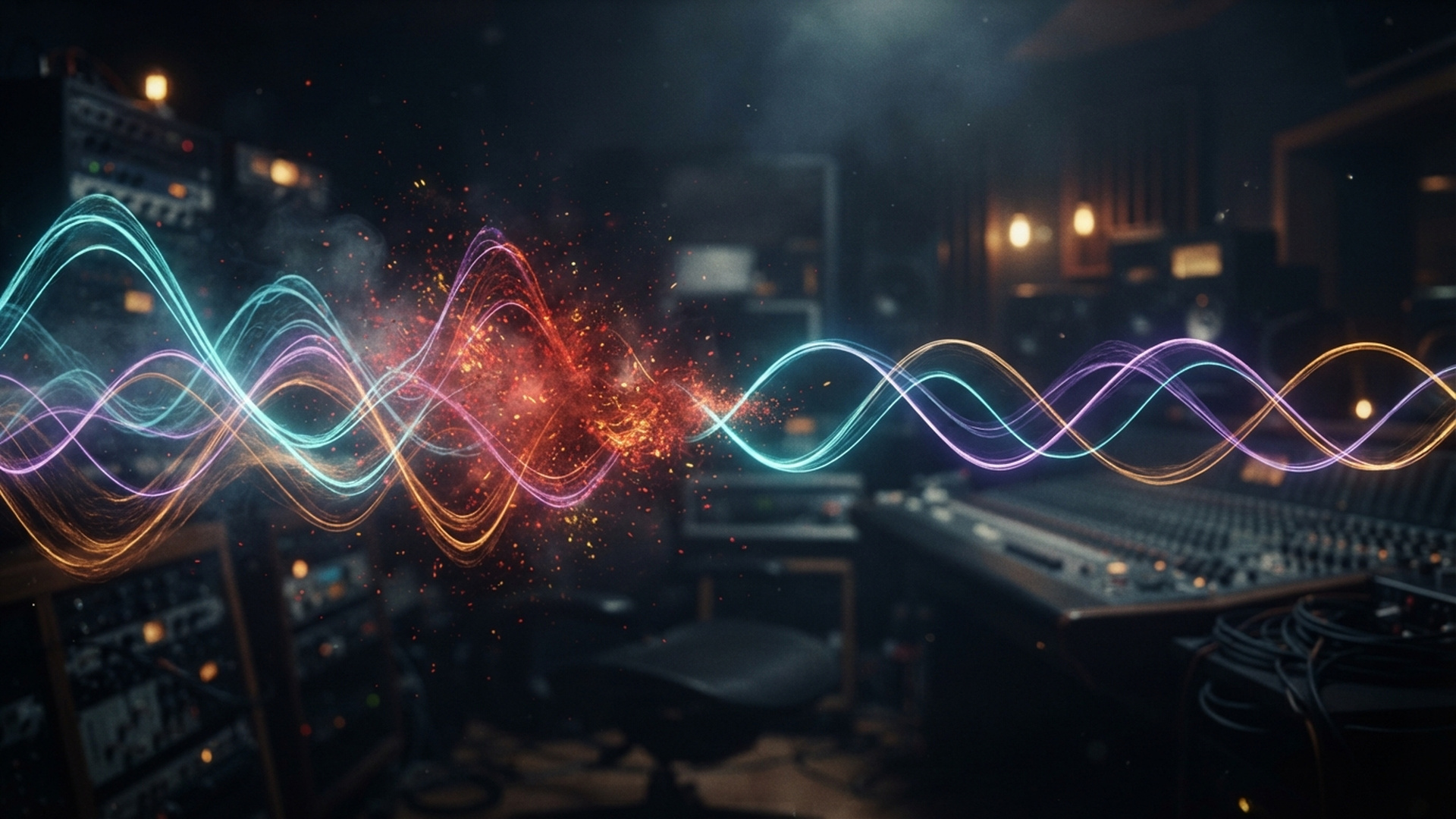
Intermodulation distortion arises when two or more simultaneous signals are processed by a nonlinear audio or electronic stage, creating sum-and-difference frequency products not present in the original input. Unlike harmonic distortion, which generates integer multiples of a single input frequency, IMD produces entirely new, non-harmonic frequencies.
These non-harmonic products are particularly problematic because they can sound dissonant, harsh, or 'muddy,' degrading the perceived quality of a mix. They are often difficult to detect by ear alone, especially in dense musical passages, as they can be masked by the primary audio content.
A dual-tone IMD test is the primary tool for making these non-harmonic products visible on a spectrum analyzer. This test allows engineers to distinguish specific nonlinear behavior from ordinary harmonic distortion and broadband noise, providing clear visual evidence of IMD generation within a system.
Why IMD Matters More Than You Think
IMD is a critical, often overlooked, form of distortion that significantly degrades audio quality. It can manifest as a subtle harshness, muddiness, or a loss of clarity and separation in complex mixes, even when no obvious clipping is present and traditional Total Harmonic Distortion (THD) measurements appear acceptable.
The insidious nature of IMD lies in its ability to create new frequencies that are not musically related to the original signals. These 'ghostly' or dissonant qualities can reduce the perceived space between instruments, making a mix sound congested or 'wrong' in a way that simple clipping does not.
Crucially, low measured harmonic distortion does not guarantee low intermodulation products under complex material. This necessitates a combined approach of critical listening and level-dependent measurement to accurately assess and address IMD issues.
Systematic Diagnosis with Dual-Tone Tests
The most effective way to diagnose IMD is through a systematic approach centered on dual-tone tests. This involves generating two pure sine waves at specific, non-harmonically related frequencies (e.g., 70 Hz and 7 kHz) and feeding them into the suspected audio stage or chain.
Monitoring the output spectrum with a spectrum analyzer is essential. The presence of new frequencies that are not harmonics of the input tones, specifically sum-and-difference products (e.g., 7 kHz - 70 Hz = 6930 Hz, 7 kHz + 70 Hz = 7070 Hz, and their higher orders), is the definitive indicator of IMD.
A key diagnostic step is to systematically vary the input level to the stage. IMD often increases disproportionately when an audio stage is driven into nonlinear operation. Observing how the IMD products change in amplitude relative to the fundamental tones helps pinpoint the exact threshold where the nonlinearity becomes problematic, allowing for precise identification of the responsible stage.
Step-by-Step Practical Method
- **Set up a dual-tone test:** Generate two pure sine waves (e.g., 70 Hz and 7 kHz) and feed them into the suspected audio stage or chain.
- **Monitor the output spectrum:** Use a spectrum analyzer to observe the output. Look for new frequencies that are not harmonics of the input tones, specifically sum-and-difference products (e.g., 7 kHz - 70 Hz = 6930 Hz, 7 kHz + 70 Hz = 7070 Hz, and their higher orders).
- **Vary input level systematically:** Gradually increase and decrease the input level to the stage. Observe how the IMD products change in amplitude relative to the fundamental tones. A disproportionate increase in IMD products with level indicates a nonlinear stage being overdriven.
- **Isolate the problem stage:** If the entire chain is tested, methodically remove or bypass stages to pinpoint the specific component or device responsible for generating the IMD.
- **Distinguish from other distortions:** Ensure the observed products are indeed IMD and not just broadband noise or simple harmonic distortion (which would be integer multiples of the input tones).
Practical Example
An audio engineer is mixing a track and notices a subtle harshness or 'muddiness' in the upper mid-range when a bass guitar and a vocal track are both active, even though individual tracks sound clean and no obvious clipping is present. A traditional THD measurement of the master bus shows acceptable levels. Applying a dual-tone test (e.g., 100 Hz and 5 kHz) through the master bus compressor reveals new, non-harmonic frequencies (e.g., 4900 Hz, 5100 Hz) appearing in the spectrum only when the compressor is engaged and driven hard. By reducing the input gain to the compressor or adjusting its threshold, these IMD products are significantly reduced, and the perceived harshness in the mix disappears, restoring clarity.
Mistakes to Avoid
- Relying solely on low harmonic distortion measurements, which do not guarantee low intermodulation products under complex material.
- Failing to systematically isolate the problem stage, leading to misdiagnosis or an inability to pinpoint the exact source of IMD.
- Misinterpreting broadband noise or simple harmonic distortion as IMD, leading to incorrect troubleshooting.
- Not varying the input level during testing, thus missing the threshold at which IMD becomes significant.
When Not to Use This Technique
- When controlled nonlinearity is desired for musical effect, such as with certain vintage-style compressors or tube preamps that introduce desirable 'warmth' or saturation. The goal is to identify undesirable or excessive IMD, not to eliminate all nonlinearity.
- As a replacement for critical listening in the context of the full program material. A spectrum analyzer clarifies what is happening, but the ultimate judgment of sound quality remains with the human ear.
- When expecting a single, simple solution for IMD that may be distributed across multiple stages in an audio chain, requiring careful, methodical isolation rather than a quick fix.
Tradeoffs
- Controlled nonlinearity can be musically useful, but increasing level into a nonlinear stage can also create masking products that reduce separation.
- A spectrum analyzer clarifies what is happening but does not replace listening in program context.
Conclusion
Intermodulation distortion is a critical, often overlooked, form of distortion that requires specific diagnostic techniques beyond standard harmonic distortion measurements. By understanding its origins and employing dual-tone tests with spectrum analysis, audio professionals can effectively pinpoint and mitigate IMD, leading to cleaner, more transparent, and more separated mixes.
Related Reading
- Intermodulation Distortion — National Instruments. Useful for the measurement definition and test setup.
- Intermodulation - Something 'New' To Ponder — Elliott Sound Products. Useful audio-specific context on why non-harmonic products can be troublesome.